Proudly Serving Survivors since 1973…
Since 1973, RCC Sexual Violence Resource Center (formerly Rape Crisis Center) has been part of a movement to ensure that survivors of sexual violence are met with compassion, dignity, and support. As one of the nation’s first rape crisis centers, RCC has spent more than five decades advocating for survivors, supporting their loved ones, and helping shape a more responsive, survivor-centered approach to care.
Today, we carry that legacy forward through trauma-informed, culturally responsive, and compassionate services that honor each person’s unique experiences, needs, and choices. We recognize that healing is not linear, there is no single path forward, and every survivor deserves to be heard, believed, and supported without judgment.
It is our honor to serve survivors and their loved ones, wherever they are in their healing journey. Whether someone is navigating the immediate aftermath of sexual violence, processing an experience from years ago, or seeking support for someone they care about, RCC is here to meet them where they are—with care, connection, and the understanding that healing happens on each person’s own terms.

Our Mission
RCC advocates for those harmed by sexual violence by centering survivors, promoting societal change, and committing to be an evolving force for social equity.
Our Vision
RCC envisions our community free from sexual violence and all forms of oppression.
Our Approach to Victim Services
All services, programs and community work of RCC are anchored by our core commitment of advocating for those harmed by sexual violence, through centering survivors, promoting societal change and always improving the depth of our work. Critical to this mission is embedding a trauma informed and intersectional lens to our approach to services and engagement in community coordinated efforts.
Trauma-Informed
Trauma informed practices in victim services covers a wide framework of approaches, but generally involves understanding how the resulting trauma from experiences impacts a person’s health, thoughts, feelings, behaviors, communications and relationships. This approach considers how to ensure that the steps to support victims takes a holistic appreciation of the potential effects of trauma, and consequently evaluates and adjusts services to be responsive to those needs.
In Practice.
At RCC, both in the development of our services, as well as the engagement with the community coordinated efforts, this approach means being survivor centered. We work to evaluate our approach to communication, client engagement, advocacy, trainings, imagery, and even our physical spaces to filter through an understanding of how every choice we make is an opportunity to support stabilizing victims who have experienced trauma. This is not a single action, instead we consider this a dynamic practice always evolving to meet the individual needs of those we serve. In the community, this includes advocating to change how different systems engage with survivors, and developing ways they can center the impacts of trauma in their own work.

An Intersectional Approach
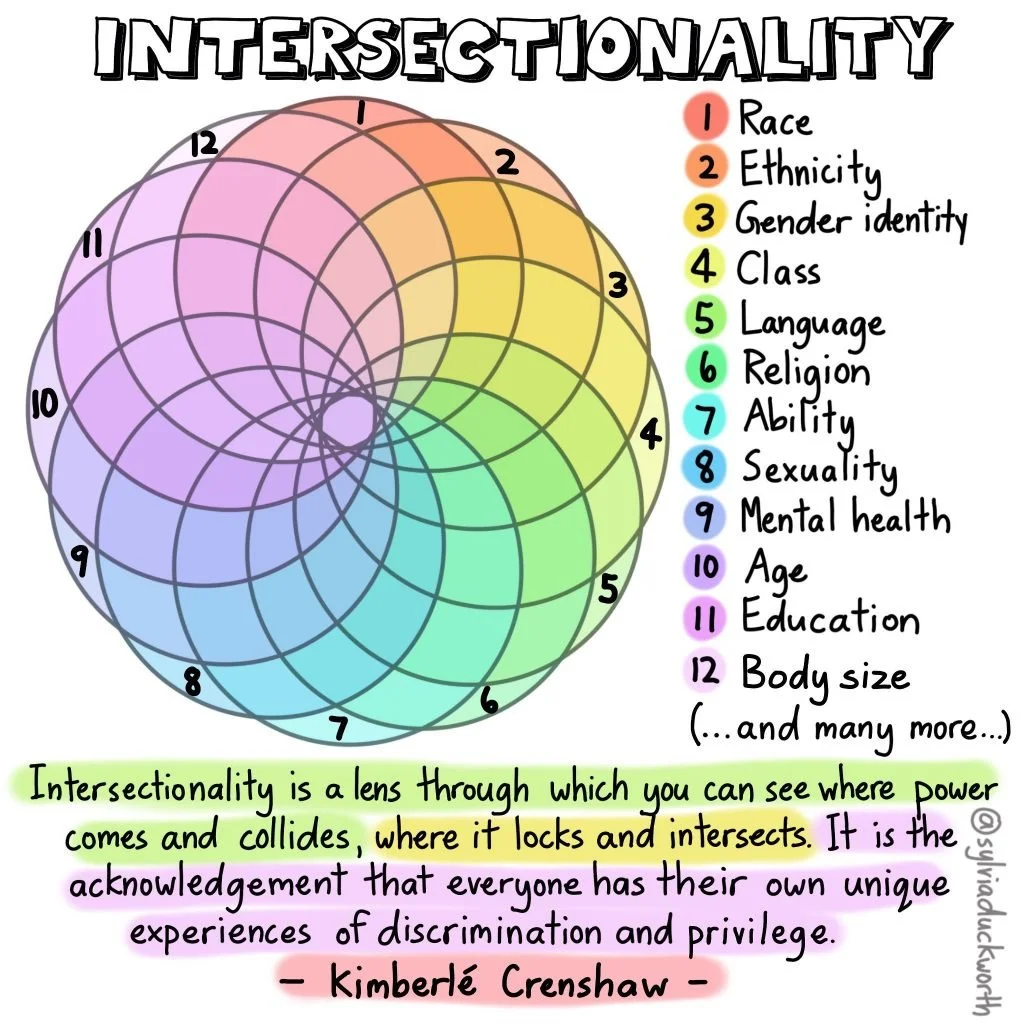
Intersectionality emphasizes an understanding of how a person’s societal and political identities combine to create distinct forms of discrimination and privilege. This includes, but is not limited to, identities such as gender, sexuality or race can have overlapping or interacting impacts on how individuals are treated and the outcomes they may experience in any areas of their life.
In Practice.
This understanding becomes an important framework for developing and evaluating our services and community engagement. The existence and pervasiveness sexual violence directly correlates with systems of oppression in our society and the uneven outcomes rooted in social and political identity. When we consider the approach of services, individuals at the table, the resources we offer, and the way we engage with communities, we work to consider the complex needs that emerge in the varying identities of the survivors we serve. This approach calls on us to develop an equity driven practice that accounts for the range of unique challenges each victim faces. It also also requires that in our community work, we are advocating for how we can leverage cross-sector support to meet these challenges and needs.

Frequently Asked Questions
Don’t see the answer to your question? Call or text RCC’s 24/7 anonymous helpline at 608-251-7173 or la línea de ayuda at 608-258-2567.
-
Sexual violence is an umbrella term defined as any sexual behavior that happens without a person’s consent. This can include, but is not limited to: Rape (statutory, marital, date), child molestation, incest, assault, unwanted groping/fondling, stalking, verbal or physical harassment, voyeurism, flashing, trafficking, etc. These are all acts in which sex is used as a tool of power, control, intimidation and violence.
-
At RCC, we are careful to not define anyone’s experience for them. What we can do is provide you with information to make an informed decision about what you experienced so that you can determine your own needs and the healing journey that is right for you.
Depending on who you are, it can feel either empowering or traumatizing (or anything in between) to assign a label to what you experienced. Regardless of what you or anyone may label it as -- if a sexual experience made you feel uncomfortable, powerless, ashamed and/or angry, we are here to support, empower, validate and listen to you. -
Absolutely! If you have confusing or negative feelings about a sexual encounter, or feel that something just isn’t right - it can be incredibly helpful to talk with an experienced advocate or therapist. Even if you end up deciding that you were not assaulted, it can still bring up lots of complicated feelings. Navigating these feelings with a trusted and confidential advocate is always available to you – you don’t have to go through it alone!
-
Yes. Our services are open to any person of any gender or sexual identity who has experienced or been affected by an assault.
-
No. At this time RCC services are only designed to support victims and their support people.
-
All services at the RCC are confidential. We may be required to make reports to law enforcement about disclosures of suicidal or homicidal intent.
-
RCC advocates carry out a special role different from law enforcement and medical personnel. Their role is to offer the survivor support and information about the process, including the available options in an investigation or medical exam, and appropriate referrals. They will never meet with law enforcement or medical personnel without the survivor or the survivor’s express permission. They will never tell you what decisions to make. Their job is to support, affirm and offer resources for every step of a survivor’s healing journey.
-
All advocacy, support groups, and emotional support services are provided by the RCC at no charge.
There may be fees associated with some educational offerings (trainings, Chimera Self-Defense, and Safer Bar).
-
Our youth services are available to Dane County youth ages 12-18. An RCC advocate can meet with you at RCC’s main office OR at your school OR virtually. You can schedule an appointment by calling our helpline (608-251-7273). Please ask your counselor if your school provides any additional services such as support groups.
-
Sexual assault is a serious crime. If you choose to report your assault to law enforcement, the District Attorney’s office decides if there is enough evidence to bring charges against the assailant. If convicted, it is possible that the assailant could receive a jail or prison sentence. Contact the RCC if you would like to talk with an advocate about the possible outcomes of filing a police report.